
- September 2026: Meeting agenda and Design Tools
Insight: Finding Tremendous Alignment
Last month I facilitated a meeting with a group of high-level provincial leaders. The group was coming together to find alignment in how they talk about key policy issues. The meeting involved an open discussion of differences of opinion and an effort to bridge diverse viewpoints to find common ground.
One of the leaders expressed that he was nervous coming into the meeting, fearing that opening up a discussion of differences would be divisive. But he was surprised to find that the group came to “tremendous alignment” by the end of the day. I believe that one of the reasons for this is that I worked with the group to clearly identify the outcomes for the day, and throughout the day, used gentle reminders to help them stay on track towards meeting their outcomes. I also shared that 100% alignment isn’t possible, or even desirable – having diversity within unity brings strength to the group. But there needs to be enough alignment to move forward together towards a clear vision.
As a facilitator, I see myself as a host and a tool. My purpose is to create the conditions for meaningful conversation and decision-making, and ideally, I want the client to use my skill sets to help them achieve their goals. As I shared at the start of the session, “This is your meeting, not mine.”
For that reason, I always prefer to work collaboratively with clients to design meetings or projects, rather than deliver pre-packaged solutions. To prepare for this meeting with a brand-new client, I worked with a small number of people from the organization to co-design the meeting goals and agenda. I may have expertise in facilitating group discussions, but the client is the expert on their own goals and context.
In this edition, I’m going to share two tools that are foundational to my facilitation practice. I find these tools useful in all kinds of contexts, not only to design meetings, but also to co-develop project approaches.
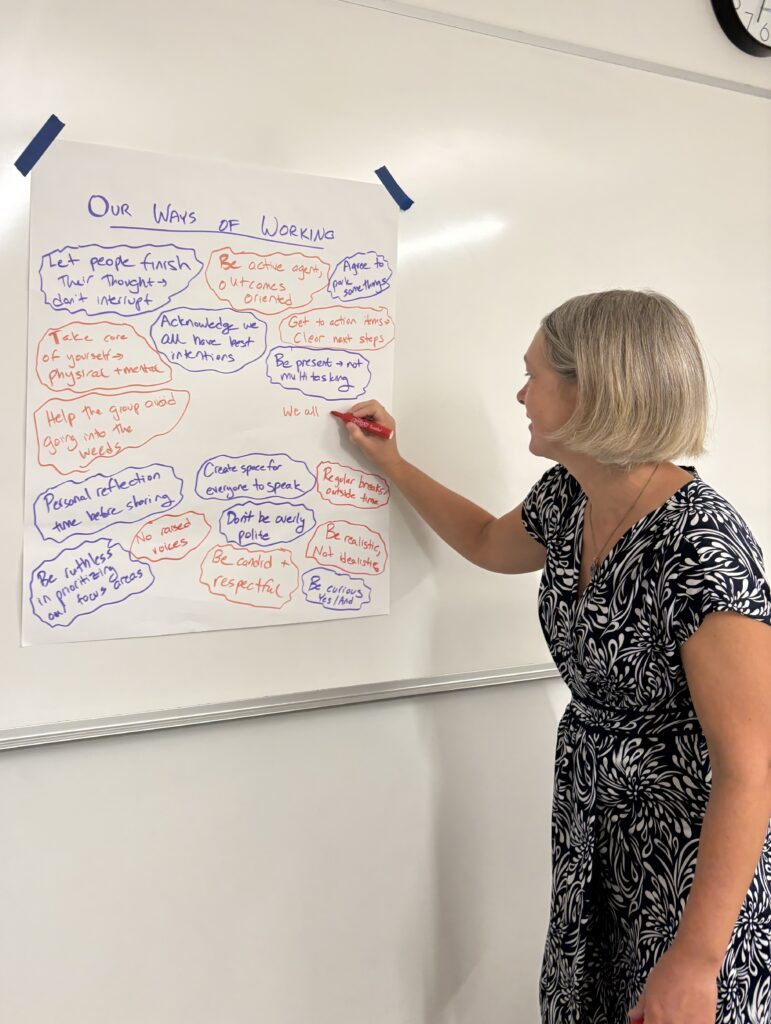
I was first introduced to these tools 17 years ago at an Art of Hosting Training in Nanaimo, B.C. I was three-months pregnant with my second child, extremely nauseous and repulsed by most foods, and unable to get through the day without napping. But I went to the training anyway because I was so excited about learning new facilitation skills.
It turned out to be the right choice as it was the best training I’ve ever attended and shaped the future direction of my career. I fell in love with the role of facilitator, coach and guide – helping people and organizations to arrive at their goals – and I gained valuable tools to do so.
Tool One: Divergence-Emergence-Convergence
This model is pretty simple to understand. Most productive meetings go through an evolution that looks something like this:
- Divergence: The meeting begins with generating and sharing a lot of diverse ideas. This might look like brainstorming, dialogue, or even debate.
- Emergence: Gradually, with the help of a good facilitator, themes and patterns start to emerge. Key similarities and differences take shape, and next steps start to form.
- Convergence: Decisions are made, next steps are chosen, and the products of the meeting are developed. When the meeting is well-designed and facilitated, the results of convergence directly address the meeting goals.
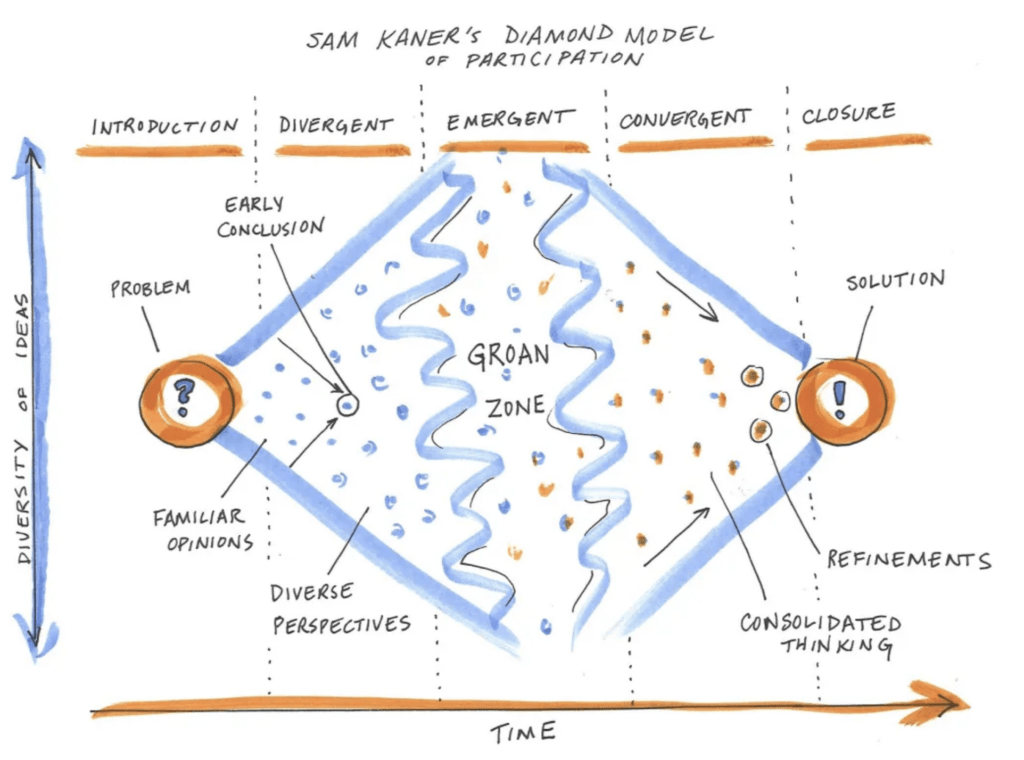
The main thing I like about this model is that it helps people to understand they don’t need to fear the “groan zone.” This is where ideas get born and innovation emerges. It can feel tricky at times: overwhelming, confusing, unclear, even frustrating. One of my skills as a facilitator is helping groups to find clarity from chaos, and working through the groan zone is a necessary step to get there. In fact, if there’s not a groan zone, that’s a red flag to me, suggesting that maybe we’re not getting into the heart of the issues on hand.
The other thing I appreciate about this model is that is guides me as a facilitator. I am secretly on the lookout for that golden moment when I need to switch the group’s focus from divergence to emergence, and from emergence to convergence, so that they will get to where they hoped to be by the end of the day. After many years of experience, I have an innate sense of these subtle shifts, but even early on, knowing the model helped me to plan the meeting and to pay attention to the overall flow of conversation.
Tool Two: Chaordic Stepping Stones Questions
This model is adapted from work done by one of my early facilitation teachers, Chris Corrigan, and my current colleague pawa haiyupus. When I first meet with clients, for either new meetings or projects, I usually go through this set of questions with them. This is best done orally, as in conversation the subtleties come out. However, I send the questions in advance so the client can think them over.
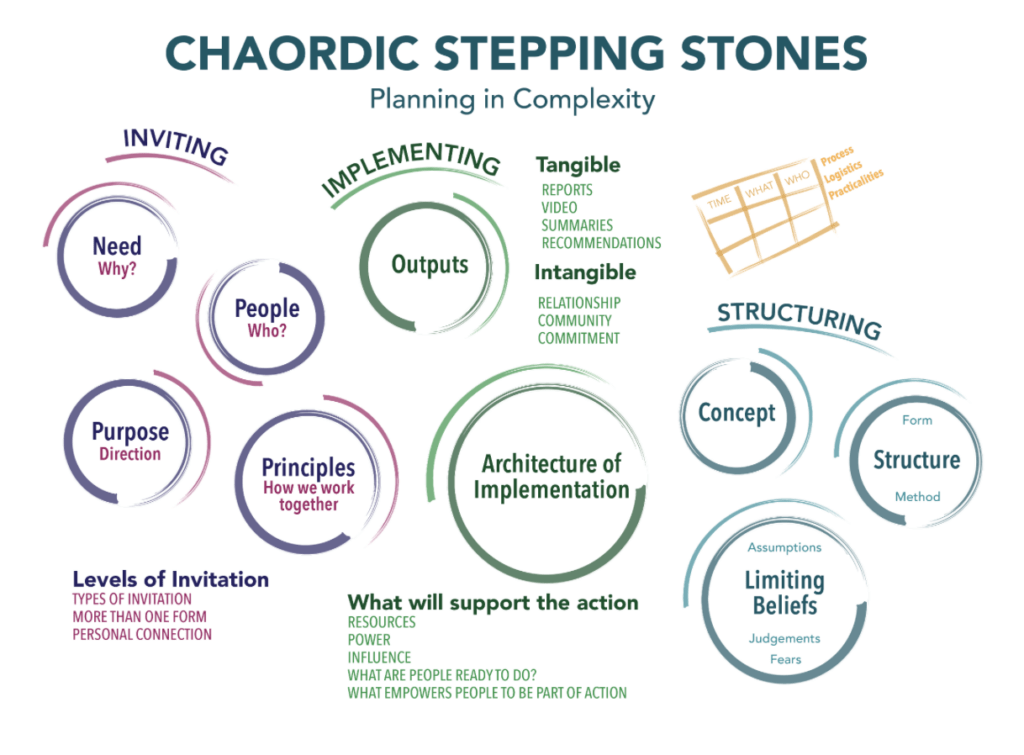
Here are the questions, with a brief explanation of why they are so powerful:
Question Why it’s powerful Need: Why is it important that we do this work at this moment in time? If I know why the client is coming to me, I understand the context and the need. This is a more in-depth way of asking, why are you even doing this work? Purpose: What is our highest aspiration for this project? If we could achieve this in our work how would the lives of those we serve be better? Whenever I design a meeting or project, I start with the goals first and design it to meet those goals. Starting with activities is risky – you can have a bunch of activities that ultimately don’t lead where you want them to. And if the group isn’t aligned on the purpose, they don’t have much hope of aligning on the outcome. A clear purpose is the foundation of good meeting or project design. People: Who are the key participants who will be attending? Why have these people been selected? What are the roles of each person on the planning team? This question helps me to understand the audience, the group dynamics, and the roles of each person who I will work with. Understanding this allows me to tailor the meeting or project design to that particular audience and dynamic. Principles of Cooperation: What is it important to remember about how we want to work with each other and the participants in our initiative? This is more about the how of the meeting or project. Finding agreement on how the group wants to work together and how they want to interact helps me to support that intention throughout our journey together. Harvest: What are we hoping the tangible and intangible results of our work will be? Because I’m big on achieving results, I can’t understate how important this question is. And particularly the tangible. I want to know what the physical output of the meeting or project is: A report, a workplan, a clear decision, an agreement on next steps, etc.? If I know what the desired result is, I can help the group to get there. Limiting Beliefs: What do we fear about new ways of working together? What are the elephants in the room that I should know about in advance? I also love this question. It’s a gentle way of asking about the underlying tensions, preparing me for the meeting or project so that I’m not blindsided. Often people will speak quite candidly about this when asked, and it helps me to anticipate and mitigate any risks to the meeting or project’s success. The answers to these questions give me what I need to create an initial agenda or project plan draft that I then refine with the client. And throughout the meeting or project, I can return to these questions and check in to see if the purpose, ideal outcome, audience or limiting beliefs have changed.
Working with me
I use these tools in all areas of my work:
In strategy and execution, I use those tools to help clients get clear on their goals, allowing me to create a process that works for their needs.
In facilitation and team coaching, I use these tools to collaboratively identify the goals and desired outputs of a meeting or team coaching process.
In reconciliation and cultural safety, I use these tools co-design processes based on the relationships, needs and contexts the clients and the Indigenous communities they work with.
If you want to learn more about any of these services, email me, check out my website, or find me on LinkedIn.
- May 2026: The “rocks” approach to planning
Insight: An evolving approach to strategic planning
I’ve been supporting organizations to build the future they desire since 2002. My first strategic planning experiences occurred while working as a volunteer with a youth-led organization in Tanzania.
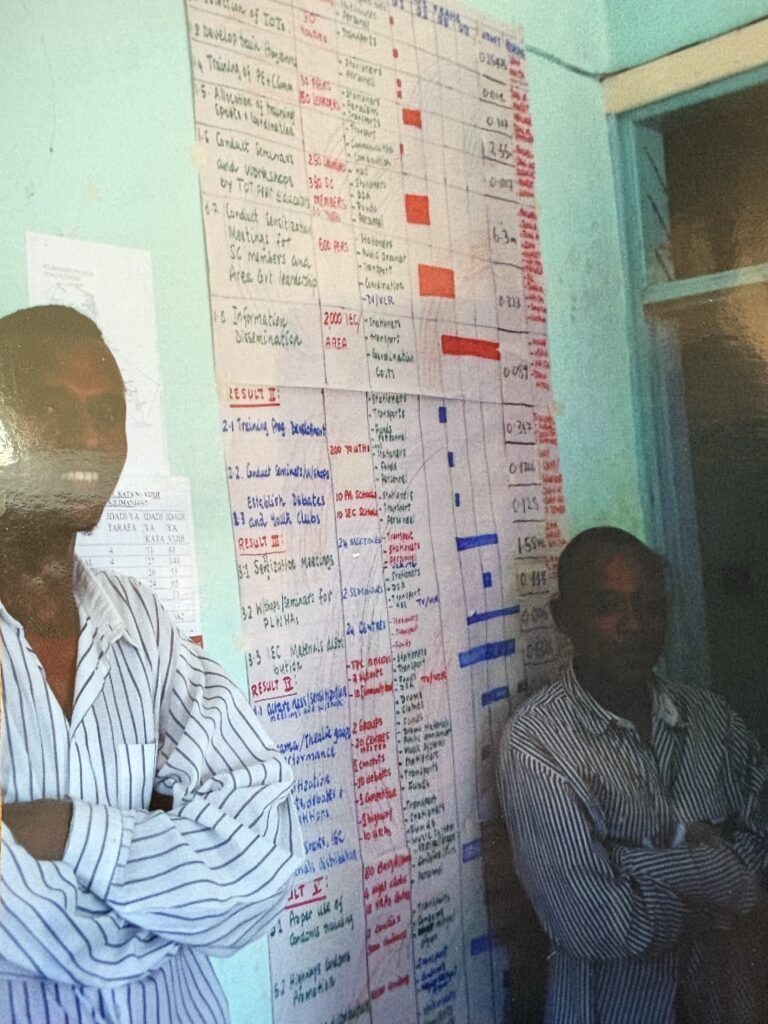
Physical resources (from operational funding to office supplies) were extremely limited, but human resources were abundant, as these youth worked tirelessly, for little to no money, to improve their communities. Here is one of the early strategic plans I worked on (shown here with two of the youth I worked with – apologies for the poor image quality, this was 24 years ago!):
Over the years, my approach to planning has become increasingly streamlined. In the early days, a strategic plan would be a months-long undertaking resulting in a 20-40 page document with detailed timelines and accountabilities.
As I worked with more clients, I started to gravitate towards a more agile structure where planning was more emergent and responsive to ever-changing contexts, and a “strategic plan” could be a 1-page graphic or a few lines of text expressing a high-level purpose and goals.
Currently, I’ve settled somewhere in the middle. Organizations do need to be crystal clear on their long-term vision, and everyone in the organization should be able to describe in simple language why they exist, why their work matters, and where they are going.
At the same time, reality is messy, and plans don’t always materialize in the way they think they will – sometimes the results are less than we expected, but sometimes they surpass anything we could have imagined.
One method I’ve been using lately is the “rocks” approach to planning. Here is a brief description of what it is and how to use it.

Tool: The “rocks” approach to planning
The “rocks” approach works well when organizations have a clear long-term vision and mission. If you don’t already have a clear vision that everyone in your organization is informed about, you need to start there first. One approach is the Entrepreneurial Operating System’s Vision/Traction Organizer, a template which uses a 10-year target and a 3-year picture, but there are many ways to do this.
Once you have a clear long-term vision and everyone on your team understands your organizational purpose, you can work as a team to identify your rocks. The term “rocks” comes from a metaphor popularized by Stephen Covey. Imagine there is a glass cylinder that represents all the time you have in a day. Next to the cylinder are:
- Rocks (your big priorities)
- Pebbles (your day-to-day responsibilities)
- Sand (interruptions)
- Water (everything else you get hit with during the day)
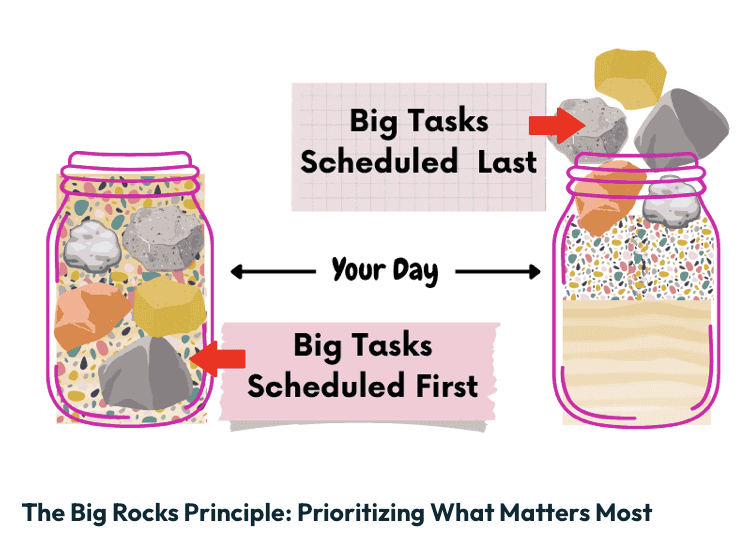
If you put in the water, sand and pebbles first, you won’t have any space for the rocks. But if you put the rocks in first, the other elements can be added and will settle around the rocks, with everything falling into place. The lesson is to prioritize what is most important, set clear and achievable goals, and break the habit of trying to focus on everything at once.
Why it works
The rocks approach works because it forces teams to limit their priorities to those that matter most. As business guru Patrick Lencioni says, “If everything is important, then nothing is.” By limiting priorities, you can focus on what’s most important. The most successful teams are clear on the outcomes that want to achieve and work in alignment towards those outcomes.
It also works because it combines a long-term vision (which can feel inspiring, but also overwhelming or vague) into shorter, more tangible, achievable steps.
And finally, when checking in about rocks is integrated into weekly or bi-weekly team meetings, it ensures that they team stays focused and supports each other when barriers arise, before issues become fires that need to be put out.
How to use a “rocks” approach to planning
There could be many ways to come up with your rocks. Here are a few methods I have used.
As a team
1. Review your vision and purpose: Meet together, virtually or in-person. If your organization has a clear vision or purpose statement, begin by making sure everyone on the team knows what it is and how it relates to your work. If not, do that work first
2. Brainstorm: As a team, engage in a brainstorming session around the question: What do we want to achieve in the next 100-days to support our organizational vision/mission? Using sticky note brainstorming (or an online equivalent) is a good way to get everyone’s ideas out there. During the brainstorming, resist the urge to talk with each other: Some people need the quiet to do their own thinking, and you want the best of everyone’s ideas.
When everyone is done generating ideas, it’s time to share. At this point, don’t limit yourself. Every idea is at least 10% good, and that 10% may be the foundation for the next great idea! Think of as many ways as possible that you could achieve the future you’ve envisioned.
3. Prioritize: Finally, start to narrow it down using a consensus-based process. What are the 3-5 most impactful things you could do in the next 100-days to bring your vision to life? Compare all the ideas you’ve come up with, and choose those that are both realistic, urgent and high-impact. Discuss and debate until the whole group agrees to the 3-5 rocks you’ve selected. Don’t try to do everything at once or plan too far ahead – limit the number of rocks and the time-period (the next 100 days).
Rocks must be:
• Clear and measurable – there should be no doubt about whether they have been achieved or not after the 100-days is complete
• Have a due date
• Be assigned a lead person who is accountable for that rock4. Integrate: Once you’ve identified your 3-5 rocks, that is only the beginning. This exercise will be useless if you don’t build in a regular check-in process. Meet weekly, or at least every other week, to discuss how you are doing on your rocks and where you might need to address internal or external barriers to move forward.
5. Repeat and Improve: When 100 days has passed, meet as a team to reflect on the process and what could make it even better. Then repeat, tweaking it each time to support continuous improvement. It will take time to learn this system, but the end result will be a more focused and effective team.
In doing this work, you will not only clarify your team’s strategy, but also you will improve on the five elements of a high-performing team: A clear reason for existing, alignment about your goals and roles, open and positive communication with each other, awareness of internal and external needs, and learning about how you work best as a team.
If you’re stuck with this, team coaching may be a great fit for your team. It builds leadership in practice, so that developing as a team is linked to getting your work done effectively within a healthy work culture. If you want a guide throughout the process, consider strategic business planning.
As an individual
1. Clarify your vision and purpose: Start by getting out of your head. One way to do this is through a vision board or art activity focused on the question “What do I want the next year of my life to be like?” Feel into what really matters to you and what would make your life better. Another option is a silent nature walk, followed by some journaling on your vision.
2. Brainstorm: Once you have a clear vision, start brainstorming. If possible, use a physical method like a notebook (include doodles if you want) or putting each of your ideas on a sticky note and grouping them by theme. At this point, don’t limit yourself. Think of as many ways as possible that you could achieve the future you’ve envisioned.
3. Prioritize: Finally, start to narrow it down. What are the 3-5 most impactful things you could do in the next 100-days to bring your vision to life? Compare all the ideas you’ve come up with, and choose those that are both realistic and high-impact.
Write down your 3-5 rocks and place them somewhere that you will be able to see them frequently. Don’t try to do everything: Limit yourself to those 3-5 rocks and a 100-day time period. Think about who might you need to involve, or what resources you might need, to be successful at achieving your rocks. Plan out a schedule for when you will work on each of them.
4. Integrate: Build in a regular reflection time in your calendar (for example, once a week) to think about how you are doing on your rocks and where you might need to get unstuck.
5. Repeat and Improve: When 100 days has passed, reflect on the process and what could make it even better. Then repeat, tweaking it each time to support continuous improvement.
Personal leadership coaching can be a great tool for staying motivated and getting unstuck, and so can connecting with an accountability buddy, friend, or partner. Arrive’s One Clear Day workshop also provides a guided, interactive experience of creating a 100-day plan.